Approaching the corner of Washington and Dean Street, there is a lavender hue seeping onto the road, replacing the orange sunlight. A faint flicker disrupts the purple glow, revealing itself to be a constellation of eyes staring back at those who cross the street. The big windows of The Shirley Project Space are almost iridescent, oozing with light and color from Allison Kaufman’s exhibition Smooth Confident Perfection.
Allison Kaufman is a photographer, video and installation artist living in New York City, and she teaches in the Undergraduate Film and Television Department at Tisch School of the Arts, NYU. According to the press release, Smooth Confident Perfection “explores the performance, hope, and vulnerability experienced by both sellers and consumers in a capitalist society.” Through a recontextualization and reexamination of overlooked, worn, and gendered marketing materials, Kaufman attempts to uncover the dwindling efforts of salespeople, and the absurdity of societal aspirations. Through photography, installation, and video, Kaufman unpacks the complexities of the American mythology, proving itself to be rooted in fantasy rather than reality.
Walking into The Shirley Project Space, you are immediately pulled towards the web of luminescent lightboxes along the main wall. Being cautious not to tumble over the free-standing boxes on the floor, the viewer is invited to immerse themselves in the warm light and examine the aluminum sculptures. Upon further inspection, the signs appear to be scratched and weathered, streaked with peeling tape and green sludge, despite their shiny frames. Taking a few steps back, the lightboxes, in various shapes and sizes, spill into the gallery, as if they are resting on an invisible mound. While there is a sense of intentionality, the signs’ organic arrangement coupled with the light emitted from the neon sign (reading “Smooth Confident Perfection”), turns the gallery into an almost otherworldly environment.
Willoughby Thom — March 2024
Allison Kaufman, Aspirational Vestiges (2024), aluminum, LEDs, and vinyl, dimensions vary.


As the centerpiece of the show, Aspirational Vestigaes (2024) commands the room. Kaufman’s new installation consists of re-fabricated waxing and threading advertisements found across New York City. Named after the street for which they were found, Kaufman photographed the signs in various states of degradation, transforming them into beautifully surreal sculptures. While a somewhat site-specific installation, the work was created with additional iterations in mind, allowing it to be installed in numerous configurations.
Aspirational Vestiges explicitly toys with the seductive nature of commercial signage. The fragmented, modified, and collected advertisements were designed to be alluring, whether with unease or intrigue, drawing attention to businesses that provide intimate services (waxing, threading, lash extensions, etc.) while also representing the hope-fueled relationship between patron and vendor. On the side of the merchant, there is hope for clientele, hope for satisfied service, and hope for a profit; while the customer hopes for perfection, hopes for proper service, and hopes for a good deal. The lightboxes embody the slow degradation of the commercial and personal fantasy of perfection, revealing the ultimate and imminent decay of such unison. Out of context, the disembodied eyes not only emphasize the absence of the body, but also the omission of personhood. This degradation points to the absurdity of aesthetic ambitions and the impossibility of achieving perfection, underpinned by the complexity of emotions. Thus, such aspirations are intrinsically embedded with hope, generated by deceptive optimism.
The title, Aspirational Vestiges, speaks to this perpetual optimism. Of course, “aspirational” is defined by a desire for success, whereas the definition of “vestige” is twofold: either a trace of something that has been lost or an organ that has evolved to be inactive. As previously mentioned, the signs are fundamentally aspirational, yet they become vestiges when removed from their place of business, a reflection of commerce and exchange. The eyes, separated from the body, become vestiges in themselves: no longer operating as an instrument of sight, but as a means to be “eye-catching.”
Turning away from the installation, the eye is met with crystal blue skies and tinsel-flags fluttering in the wind on a television. It is a peaceful scene: cloudless skies, sunny days, and shimmering flags in the breeze. But, the mood changes when the ambient sound of the gallery is replaced with a man exclaiming, “Showtime!” The video sews together distinct clips of flags flowing in the heavens while a man describes the characteristics of a salesman. These flags are reminiscent of those found at car dealerships, strung high above the lot of cars, and the accompanying audio gives insight into the setting in which we are standing, watching, and listening. As the grid of flags begin to disappear, one by one, you slowly return to reality.
Acting as a counterpoint, 3rd Avenue Car Dealerships (2018) adds further dimension to the exhibition. Kaufman’s video features weathered flags found at car dealerships that populate 3rd Avenue in Brooklyn. She pairs these images with motivational audio clips by car salesmen found on YouTube. The artist explains that “the blended speeches are both earnest and insincere, echoing and informing the gender performance at play in other works in the gallery.” Like Aspirational Vestiges, the objects (cars) being sold are absent from the work, both humanizing and scrutinizing the capitalist practice of exchange.
Allison Kaufman, Aspirational Vestiges (2024), aluminum, LEDs, and vinyl, dimensions vary.
Approaching the corner of Washington and Dean Street, there is a lavender hue seeping onto the road, replacing the orange sunlight. A faint flicker disrupts the purple glow, revealing itself to be a constellation of eyes staring back at those who cross the street. The big windows of The Shirley Project Space are almost iridescent, oozing with light and color from Allison Kaufman’s exhibition Smooth Confident Perfection.
Allison Kaufman is a photographer, video and installation artist living in New York City, and she teaches in the Undergraduate Film and Television Department at Tisch School of the Arts, NYU. According to the press release, Smooth Confident Perfection “explores the performance, hope, and vulnerability experienced by both sellers and consumers in a capitalist society.” Through a recontextualization and reexamination of overlooked, worn, and gendered marketing materials, Kaufman attempts to uncover the dwindling efforts of salespeople, and the absurdity of societal aspirations. Through photography, installation, and video, Kaufman unpacks the complexities of the American mythology, proving itself to be rooted in fantasy rather than reality.
Walking into The Shirley Project Space, you are immediately pulled towards the web of luminescent lightboxes along the main wall. Being cautious not to tumble over the free-standing boxes on the floor, the viewer is invited to immerse themselves in the warm light and examine the aluminum sculptures. Upon further inspection, the signs appear to be scratched and weathered, streaked with peeling tape and green sludge, despite their shiny frames. Taking a few steps back, the lightboxes, in various shapes and sizes, spill into the gallery, as if they are resting on an invisible mound. While there is a sense of intentionality, the signs’ organic arrangement coupled with the light emitted from the neon sign (reading “Smooth Confident Perfection”), turns the gallery into an almost otherworldly environment.
Willoughby Thom — March 2024
Allison Kaufman, Aspirational Vestiges (2024), aluminum, LEDs, and vinyl, dimensions vary.
As the centerpiece of the show, Aspirational Vestigaes (2024) commands the room. Kaufman’s new installation consists of re-fabricated waxing and threading advertisements found across New York City. Named after the street for which they were found, Kaufman photographed the signs in various states of degradation, transforming them into beautifully surreal sculptures. While a somewhat site-specific installation, the work was created with additional iterations in mind, allowing it to be installed in numerous configurations.
Aspirational Vestiges explicitly toys with the seductive nature of commercial signage. The fragmented, modified, and collected advertisements were designed to be alluring, whether with unease or intrigue, drawing attention to businesses that provide intimate services (waxing, threading, lash extensions, etc.) while also representing the hope-fueled relationship between patron and vendor. On the side of the merchant, there is hope for clientele, hope for satisfied service, and hope for a profit; while the customer hopes for perfection, hopes for proper service, and hopes for a good deal. The lightboxes embody the slow degradation of the commercial and personal fantasy of perfection, revealing the ultimate and imminent decay of such unison. Out of context, the disembodied eyes not only emphasize the absence of the body, but also the omission of personhood. This degradation points to the absurdity of aesthetic ambitions and the impossibility of achieving perfection, underpinned by the complexity of emotions. Thus, such aspirations are intrinsically embedded with hope, generated by deceptive optimism.
The title, Aspirational Vestiges, speaks to this perpetual optimism. Of course, “aspirational” is defined by a desire for success, whereas the definition of “vestige” is twofold: either a trace of something that has been lost or an organ that has evolved to be inactive. As previously mentioned, the signs are fundamentally aspirational, yet they become vestiges when removed from their place of business, a reflection of commerce and exchange. The eyes, separated from the body, become vestiges in themselves: no longer operating as an instrument of sight, but as a means to be “eye-catching.”
Turning away from the installation, the eye is met with crystal blue skies and tinsel-flags fluttering in the wind on a television. It is a peaceful scene: cloudless skies, sunny days, and shimmering flags in the breeze. But, the mood changes when the ambient sound of the gallery is replaced with a man exclaiming, “Showtime!” The video sews together distinct clips of flags flowing in the heavens while a man describes the characteristics of a salesman. These flags are reminiscent of those found at car dealerships, strung high above the lot of cars, and the accompanying audio gives insight into the setting in which we are standing, watching, and listening. As the grid of flags begin to disappear, one by one, you slowly return to reality.
Acting as a counterpoint, 3rd Avenue Car Dealerships (2018) adds further dimension to the exhibition. Kaufman’s video features weathered flags found at car dealerships that populate 3rd Avenue in Brooklyn. She pairs these images with motivational audio clips by car salesmen found on YouTube. The artist explains that “the blended speeches are both earnest and insincere, echoing and informing the gender performance at play in other works in the gallery.” Like Aspirational Vestiges, the objects (cars) being sold are absent from the work, both humanizing and scrutinizing the capitalist practice of exchange.
Allison Kaufman, Aspirational Vestiges (2024), aluminum, LEDs, and vinyl, dimensions vary.
3rd Avenue Car Dealerships addresses the ubiquity of marketing materials in our visual landscape, and how numb the world has become to these dilapidated facades. The sparkling pennants are symbols of vulnerability, dreams, and fantasies of salespeople and consumers alike. Car Dealerships, like the Department of Motor Vehicles, are commonly considered to be laborious and unpleasant visits. Yet, the acquiring and licensing of cars are required in the pursuit of personal independence. Like the salesman says in the video, “I like to tell every customer I meet ‘I’m sorry’ in the first five minutes. Why? It makes me a human being. It makes me a person, not a sales-person.” Because of such contrived sales techniques, sellers are viewed as dishonest, stemming from the consumer’s inability to recognize the reciprocal relationship between itself and the vendor. Consequently, the sadness of the worn and tattered flags of Kaufman’s video reveal the inherent lies and pitfalls of consumerist culture.
The video also speaks to the fragility of the American Dream. For much of the present generation, the relationship with automobiles is intimate. It is an unbreakable codependence that reaches beyond mobility, providing people with an ongoing sense of freedom, power, and control. Wheels indicate status. Cars function to project identity into the world, establishing public perception. 3rd Avenue Car Dealerships flips the script, forcing the viewer to become the salesperson. Now, it is no longer about purchasing the car, but closing the deal and sorting through the negativity surrounding your position. It is one thing to watch Glengarry Glen Ross, but another to be immersed in the corrupt world of sales.
Turning away from the television, there appears to be a bright light shining from the accompanying gallery. On the way around the corner, there is a small silver alcove with two portraits of men, with verdant plants as faces, holding fish. Big Fish I and II (2017) are humorous, charming, and surreal images that Kaufman created by photographing photo stand-ins at the New York Boat Show. The portraits consider “the typically masculine ritual of posing with captured or hunted animals, and point to the strangeness of these performative acts.” Against a metallic backdrop, the photographs draw upon the materiality of the metal lightboxes and vehicular exchanges, embodying the absurdity of such aspirations.
Allison Kaufman, 3rd Avenue Car Dealerships (2018), single-channel looped video with sound.


Allison Kaufman, Big Fish II (left), Big Fish I (2017) (right), archival pigment print, 24” x 24”.
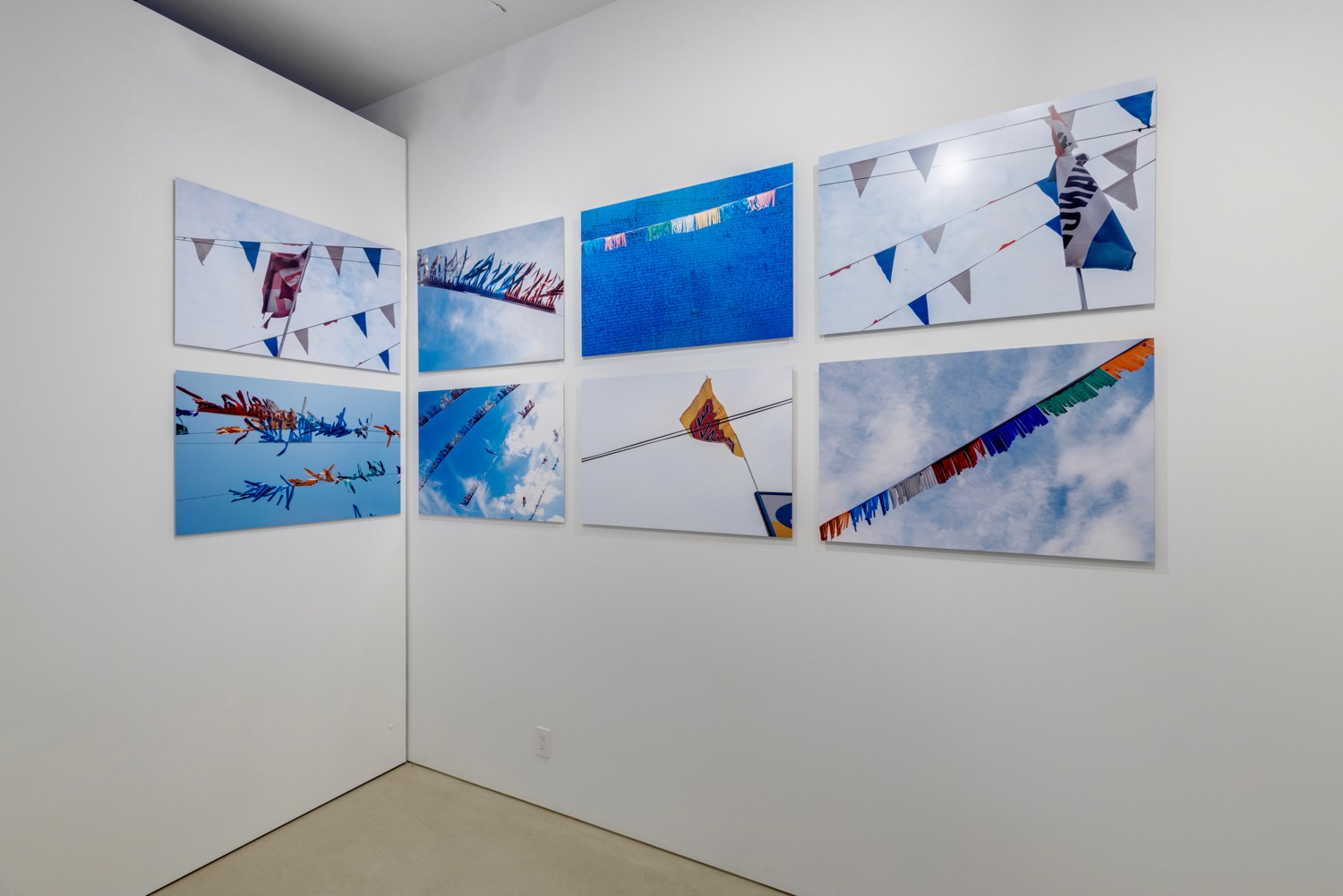
In the smaller gallery, the room is flooded with white light. Hung intentionally high, there is a grid of eight, large-scale photographs sliding around the corner. Printed on aluminum, they are beautiful stills of the car dealership flags seen in 3rd Avenue Car Dealerships. The colorful garlands, in various states of decay, proudly occupy the space, forcing you to look up at them as if they were strung across the gallery ceiling. Kaufman’s decision to print the photographs on aluminum emphasizes the materiality of cars, as well as her ability to play with disparate mediums.
Returning to the main gallery, you cannot help but be in awe of Allison Kaufman’s breadth of work. Smooth Confident Perfection is a breathtaking exhibition, showcasing the artist's interdisciplinary talents and innovative approaches to art-making. Kaufman effortlessly addresses complex themes in an approachable and accessible manner, providing new insights into the ordinary commercial landscape. Kaufman and Sarah May, the Director of The Shirley Project Space, have created an exhibition that invites you to look at commercialism through a new lens. Leaving the Shirley Project Space, I couldn’t help but reflect on the words of David Lynch, “I learned that just beneath the surface there’s another world, and still different worlds as you dig deeper... It is just a kind of feeling. There is goodness in blue skies and flowers, but another force—a wild pain and decay—[that] also accompanies everything.”
Allison Kaufman, 3rd Avenue Car Dealerships (2018/2023), dye sublimation aluminum, 24” x 36”.
3rd Avenue Car Dealerships addresses the ubiquity of marketing materials in our visual landscape, and how numb the world has become to these dilapidated facades. The sparkling pennants are symbols of vulnerability, dreams, and fantasies of salespeople and consumers alike. Car Dealerships, like the Department of Motor Vehicles, are commonly considered to be laborious and unpleasant visits. Yet, the acquiring and licensing of cars are required in the pursuit of personal independence. Like the salesman says in the video, “I like to tell every customer I meet ‘I’m sorry’ in the first five minutes. Why? It makes me a human being. It makes me a person, not a sales-person.” Because of such contrived sales techniques, sellers are viewed as dishonest, stemming from the consumer’s inability to recognize the reciprocal relationship between itself and the vendor. Consequently, the sadness of the worn and tattered flags of Kaufman’s video reveal the inherent lies and pitfalls of consumerist culture.
The video also speaks to the fragility of the American Dream. For much of the present generation, the relationship with automobiles is intimate. It is an unbreakable codependence that reaches beyond mobility, providing people with an ongoing sense of freedom, power, and control. Wheels indicate status. Cars function to project identity into the world, establishing public perception. 3rd Avenue Car Dealerships flips the script, forcing the viewer to become the salesperson. Now, it is no longer about purchasing the car, but closing the deal and sorting through the negativity surrounding your position. It is one thing to watch Glengarry Glen Ross, but another to be immersed in the corrupt world of sales.
Turning away from the television, there appears to be a bright light shining from the accompanying gallery. On the way around the corner, there is a small silver alcove with two portraits of men, with verdant plants as faces, holding fish. Big Fish I and II (2017) are humorous, charming, and surreal images that Kaufman created by photographing photo stand-ins at the New York Boat Show. The portraits consider “the typically masculine ritual of posing with captured or hunted animals, and point to the strangeness of these performative acts.” Against a metallic backdrop, the photographs draw upon the materiality of the metal lightboxes and vehicular exchanges, embodying the absurdity of such aspirations.
Allison Kaufman, 3rd Avenue Car Dealerships (2018), single-channel looped video with sound.
Allison Kaufman, Big Fish II (left), Big Fish I (2017) (right), archival pigment print, 24” x 24”.
In the smaller gallery, the room is flooded with white light. Hung intentionally high, there is a grid of eight, large-scale photographs sliding around the corner. Printed on aluminum, they are beautiful stills of the car dealership flags seen in 3rd Avenue Car Dealerships. The colorful garlands, in various states of decay, proudly occupy the space, forcing you to look up at them as if they were strung across the gallery ceiling. Kaufman’s decision to print the photographs on aluminum emphasizes the materiality of cars, as well as her ability to play with disparate mediums.
Returning to the main gallery, you cannot help but be in awe of Allison Kaufman’s breadth of work. Smooth Confident Perfection is a breathtaking exhibition, showcasing the artist's interdisciplinary talents and innovative approaches to art-making. Kaufman effortlessly addresses complex themes in an approachable and accessible manner, providing new insights into the ordinary commercial landscape. Kaufman and Sarah May, the Director of The Shirley Project Space, have created an exhibition that invites you to look at commercialism through a new lens. Leaving the Shirley Project Space, I couldn’t help but reflect on the words of David Lynch, “I learned that just beneath the surface there’s another world, and still different worlds as you dig deeper... It is just a kind of feeling. There is goodness in blue skies and flowers, but another force—a wild pain and decay—[that] also accompanies everything.”
Allison Kaufman, 3rd Avenue Car Dealerships (2018/2023), dye sublimation aluminum, 24” x 36”.
Approaching the corner of Washington and Dean Street, there is a lavender hue seeping onto the road, replacing the orange sunlight. A faint flicker disrupts the purple glow, revealing itself to be a constellation of eyes staring back at those who cross the street. The big windows of The Shirley Project Space are almost iridescent, oozing with light and color from Allison Kaufman’s exhibition Smooth Confident Perfection.
Allison Kaufman is a photographer, video and installation artist living in New York City, and she teaches in the Undergraduate Film and Television Department at Tisch School of the Arts, NYU. According to the press release, Smooth Confident Perfection “explores the performance, hope, and vulnerability experienced by both sellers and consumers in a capitalist society.” Through a recontextualization and reexamination of overlooked, worn, and gendered marketing materials, Kaufman attempts to uncover the dwindling efforts of salespeople, and the absurdity of societal aspirations. Through photography, installation, and video, Kaufman unpacks the complexities of the American mythology, proving itself to be rooted in fantasy rather than reality.
Walking into The Shirley Project Space, you are immediately pulled towards the web of luminescent lightboxes along the main wall. Being cautious not to tumble over the free-standing boxes on the floor, the viewer is invited to immerse themselves in the warm light and examine the aluminum sculptures. Upon further inspection, the signs appear to be scratched and weathered, streaked with peeling tape and green sludge, despite their shiny frames. Taking a few steps back, the lightboxes, in various shapes and sizes, spill into the gallery, as if they are resting on an invisible mound. While there is a sense of intentionality, the signs’ organic arrangement coupled with the light emitted from the neon sign (reading “Smooth Confident Perfection”), turns the gallery into an almost otherworldly environment.
Willoughby Thom — March 2024
Allison Kaufman, Aspirational Vestiges (2024), aluminum, LEDs, and vinyl, dimensions vary.
Allison Kaufman, Aspirational Vestiges (2024), aluminum, LEDs, and vinyl, dimensions vary.
As the centerpiece of the show, Aspirational Vestigaes (2024) commands the room. Kaufman’s new installation consists of re-fabricated waxing and threading advertisements found across New York City. Named after the street for which they were found, Kaufman photographed the signs in various states of degradation, transforming them into beautifully surreal sculptures. While a somewhat site-specific installation, the work was created with additional iterations in mind, allowing it to be installed in numerous configurations.
Aspirational Vestiges explicitly toys with the seductive nature of commercial signage. The fragmented, modified, and collected advertisements were designed to be alluring, whether with unease or intrigue, drawing attention to businesses that provide intimate services (waxing, threading, lash extensions, etc.) while also representing the hope-fueled relationship between patron and vendor. On the side of the merchant, there is hope for clientele, hope for satisfied service, and hope for a profit; while the customer hopes for perfection, hopes for proper service, and hopes for a good deal. The lightboxes embody the slow degradation of the commercial and personal fantasy of perfection, revealing the ultimate and imminent decay of such unison. Out of context, the disembodied eyes not only emphasize the absence of the body, but also the omission of personhood. This degradation points to the absurdity of aesthetic ambitions and the impossibility of achieving perfection, underpinned by the complexity of emotions. Thus, such aspirations are intrinsically embedded with hope, generated by deceptive optimism.
The title, Aspirational Vestiges, speaks to this perpetual optimism. Of course, “aspirational” is defined by a desire for success, whereas the definition of “vestige” is twofold: either a trace of something that has been lost or an organ that has evolved to be inactive. As previously mentioned, the signs are fundamentally aspirational, yet they become vestiges when removed from their place of business, a reflection of commerce and exchange. The eyes, separated from the body, become vestiges in themselves: no longer operating as an instrument of sight, but as a means to be “eye-catching.”
Turning away from the installation, the eye is met with crystal blue skies and tinsel-flags fluttering in the wind on a television. It is a peaceful scene: cloudless skies, sunny days, and shimmering flags in the breeze. But, the mood changes when the ambient sound of the gallery is replaced with a man exclaiming, “Showtime!” The video sews together distinct clips of flags flowing in the heavens while a man describes the characteristics of a salesman. These flags are reminiscent of those found at car dealerships, strung high above the lot of cars, and the accompanying audio gives insight into the setting in which we are standing, watching, and listening. As the grid of flags begin to disappear, one by one, you slowly return to reality.
Acting as a counterpoint, 3rd Avenue Car Dealerships (2018) adds further dimension to the exhibition. Kaufman’s video features weathered flags found at car dealerships that populate 3rd Avenue in Brooklyn. She pairs these images with motivational audio clips by car salesmen found on YouTube. The artist explains that “the blended speeches are both earnest and insincere, echoing and informing the gender performance at play in other works in the gallery.” Like Aspirational Vestiges, the objects (cars) being sold are absent from the work, both humanizing and scrutinizing the capitalist practice of exchange.
3rd Avenue Car Dealerships addresses the ubiquity of marketing materials in our visual landscape, and how numb the world has become to these dilapidated facades. The sparkling pennants are symbols of vulnerability, dreams, and fantasies of salespeople and consumers alike. Car Dealerships, like the Department of Motor Vehicles, are commonly considered to be laborious and unpleasant visits. Yet, the acquiring and licensing of cars are required in the pursuit of personal independence. Like the salesman says in the video, “I like to tell every customer I meet ‘I’m sorry’ in the first five minutes. Why? It makes me a human being. It makes me a person, not a sales-person.” Because of such contrived sales techniques, sellers are viewed as dishonest, stemming from the consumer’s inability to recognize the reciprocal relationship between itself and the vendor. Consequently, the sadness of the worn and tattered flags of Kaufman’s video reveal the inherent lies and pitfalls of consumerist culture.
The video also speaks to the fragility of the American Dream. For much of the present generation, the relationship with automobiles is intimate. It is an unbreakable codependence that reaches beyond mobility, providing people with an ongoing sense of freedom, power, and control. Wheels indicate status. Cars function to project identity into the world, establishing public perception. 3rd Avenue Car Dealerships flips the script, forcing the viewer to become the salesperson. Now, it is no longer about purchasing the car, but closing the deal and sorting through the negativity surrounding your position. It is one thing to watch Glengarry Glen Ross, but another to be immersed in the corrupt world of sales.
Turning away from the television, there appears to be a bright light shining from the accompanying gallery. On the way around the corner, there is a small silver alcove with two portraits of men, with verdant plants as faces, holding fish. Big Fish I and II (2017) are humorous, charming, and surreal images that Kaufman created by photographing photo stand-ins at the New York Boat Show. The portraits consider “the typically masculine ritual of posing with captured or hunted animals, and point to the strangeness of these performative acts.” Against a metallic backdrop, the photographs draw upon the materiality of the metal lightboxes and vehicular exchanges, embodying the absurdity of such aspirations.
Allison Kaufman, Big Fish II (left), Big Fish I (2017) (right), archival pigment print, 24” x 24”.
In the smaller gallery, the room is flooded with white light. Hung intentionally high, there is a grid of eight, large-scale photographs sliding around the corner. Printed on aluminum, they are beautiful stills of the car dealership flags seen in 3rd Avenue Car Dealerships. The colorful garlands, in various states of decay, proudly occupy the space, forcing you to look up at them as if they were strung across the gallery ceiling. Kaufman’s decision to print the photographs on aluminum emphasizes the materiality of cars, as well as her ability to play with disparate mediums.
Allison Kaufman, 3rd Avenue Car Dealerships (2018/ 2023), dye sublimation on aluminum, 24” x 36”.
Allison Kaufman, 3rd Avenue Car Dealerships (2018), single-channel looped video with sound.
Returning to the main gallery, you cannot help but be in awe of Allison Kaufman’s breadth of work. Smooth Confident Perfection is a breathtaking exhibition, showcasing the artist's interdisciplinary talents and innovative approaches to art-making. Kaufman effortlessly addresses complex themes in an approachable and accessible manner, providing new insights into the ordinary commercial landscape. Kaufman and Sarah May, the Director of The Shirley Project Space, have created an exhibition that invites you to look at commercialism through a new lens. Leaving the Shirley Project Space, I couldn’t help but reflect on the words of David Lynch, “I learned that just beneath the surface there’s another world, and still different worlds as you dig deeper... It is just a kind of feeling. There is goodness in blue skies and flowers, but another force—a wild pain and decay—[that] also accompanies everything.”
email: willoughby@willoughbythom.com
Updated Jan 2026